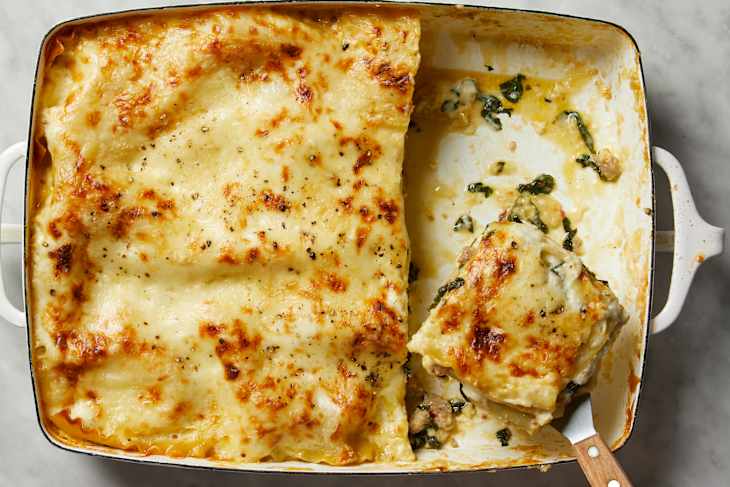
If creamy pasta makes you weak in the knees, white lasagna is going to be right up your alley. Unlike lasagnas made with marinara, you won’t find a drop of red sauce in sight. Here you get layers of hearty pasta, ricotta cheese, mozzarella, Italian sausage crumbles, and an entire pound of fresh spinach.
But what makes white lasagna so special is the creamy white sauce that’s blanketed throughout the casserole. Also known as béchamel, it’s one of the five building-block sauces in French cuisine. It’s made with a roux (equal parts butter and flour) mixed with milk, and seasoned with salt, pepper, and often a pinch of ground nutmeg.
White lasagna is certainly hearty and satisfying on its own. But sometimes it’s nice to round out the meal with a vegetable side dish or simple salad to complement dinner with something fresh. And when in doubt, remember that you can never go wrong with garlic bread.
Ready to get cooking?
Why You’ll Love It
- The impossibly creamy white sauce is irresistible. The white sauce used in this lasagna is béchamel. It’s thick and incredibly creamy, although not too rich or heavy.
- It’s cozy and comforting. This white lasagna is the perfect winter meal.
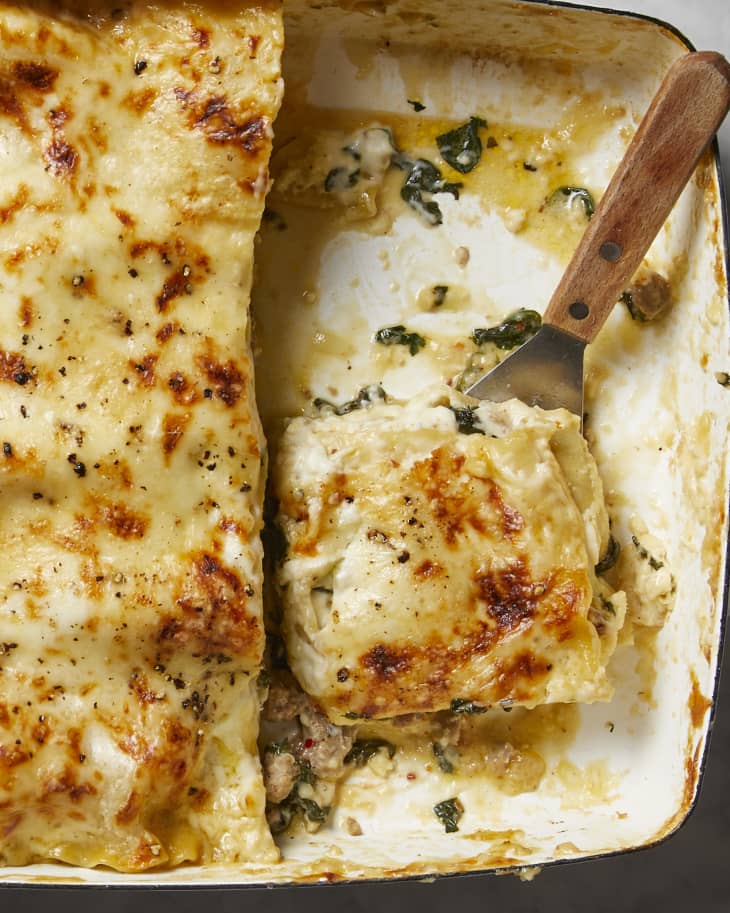
Key Ingredients in White Lasagna
- Dried lasagna noodles: Good-quality dried pasta makes all the difference (my favorite brands are De Cecco and Rummo).
- Milk: Make the béchamel with whole milk for a richer flavor.
- Flour: You’ll need 1/2 cup of all-purpose flour for the roux.
- Butter: The roux is made with equal parts flour and unsalted butter.
- Spinach: You can use baby spinach or frozen spinach.
- Cheese: Layer the lasagna with a mixture of ricotta cheese and Parmesan cheese, along with shredded low-moisture whole-milk or part-skim mozzarella cheese.
- Italian sausage: Use uncooked sweet or hot Italian sausage, casings removed if using links.
How to Make White Lasagna
- Soak the noodles. Arrange 15 dry lasagna noodles in an even layer in a 9×13-inch baking dish. Cover the noodles with hot tap water and let soak while you prepare the filling and sauce.
- Cook the sausage. Cook the Italian sausage until browned. Add the onion and garlic, and cook, stirring occasionally, until softened and translucent.
- Add the spinach. If using fresh baby spinach, add a few handfuls at a time and stir until just wilted. If using frozen spinach, add to pot and cook, stirring occasionally, until the liquid has evaporated, about 2 minutes. If necessary, drain off any liquid. Season with kosher salt and black pepper. Remove the pot from the heat and let cool.
- Make the béchamel. Melt the unsalted butter in a large saucepan over medium heat. Add the all-purpose flour, and cook, whisking constantly, until the paste is bubbling and begins to dry out slightly. Gradually whisk in the milk until no lumps remain. Bring to a boil over high heat. Reduce to a simmer, and cook, stirring occasionally, until thickened. Add kosher salt and a pinch of ground nutmeg, and stir to combine. Remove the pot from the heat.
- Make the ricotta mixture. Place half of the Parmesan cheese, ricotta cheese, kosher salt, and black pepper in a medium bowl and stir to combine. Meanwhile, drain the lasagna noodles.
- Assemble the lasagna. Place some béchamel sauce into the baking dish and spread into a thin, even layer. Arrange 5 of the lasagna noodles in an even layer on top of the sauce, breaking them if needed to fit. Dollop and spread half of the ricotta mixture over the noodles. Spoon half of the sausage and spinach over the ricotta. Sprinkle with a cup of the mozzarella. Dollop and spread a heaping cup of the béchamel over the mozzarella. Repeat with the remaining layers.
- Bake. Place the lasagna in the oven and bake uncovered until the cheeses are melted and lightly browned, and the sauce is bubbling, about 30 minutes. Let cool on a wire rack before serving.
Where to Layer the White Sauce
- Bottom of the pan. A thin layer of sauce spread over the bottom of the pan prevents the noodles from sticking to the pan.
- Between the layers. A heaping cup of sauce is added to the top of each layer, over the mozzarella.
- Over the top layer of noodles. A layer of sauce spread over the top layer of noodles prevents them from drying out in the oven.
Helpful Swaps
- Cooked vegetables: Any cooked vegetable can work in white lasagna, with roasted or grilled veggies being an especially good choice. Just be sure to avoid using raw vegetables, which can lead to a soggy lasagna because of the water content.
- Chicken breast: Shredded or chopped cooked chicken breast can be substituted for the sausage.
- Vegetarian: If you want to make a vegetarian white lasagna, the meat can be omitted altogether.
Make-Ahead and Storage Tips
- Make ahead: The lasagna can be assembled and refrigerated unbaked up to 2 days in advance, or frozen for up to 1 month. Thaw the frozen lasagna for 2 days in the refrigerator before baking.
- Storage: Leftovers can be refrigerated, tightly wrapped, for up to 3 days.